For a small business, being visible on Google can make a big difference. When potential customers search for a product or service you offer, appearing in the right place at the right time can help bring more visitors, enquiries, and opportunities. Understanding SEO vs Google Ads for small business can help you decide which approach is more suitable for your goals.
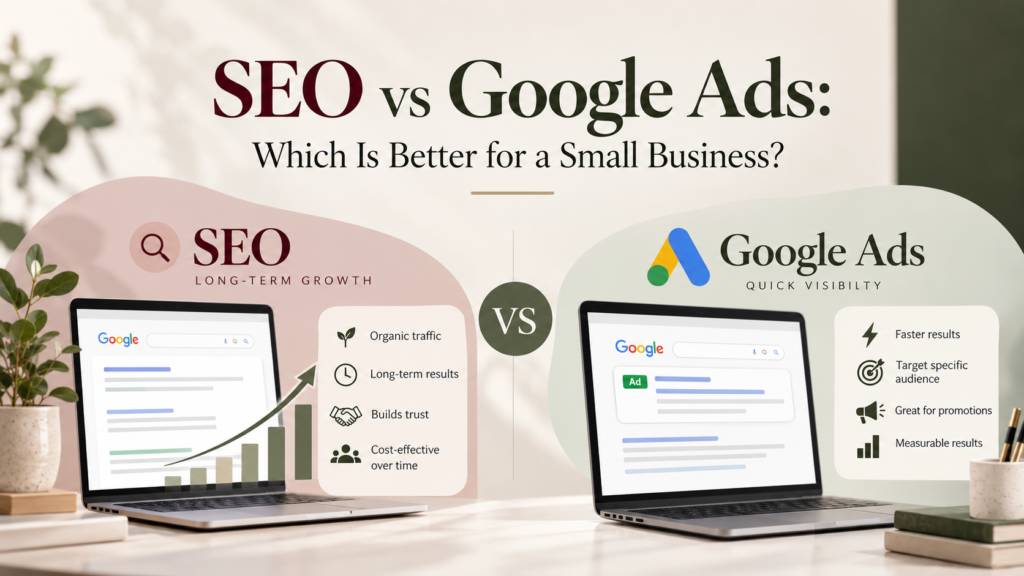
SEO (Search Engine Optimization) focuses on improving your website and online presence so that your business can appear in organic search results. It is generally a long-term strategy that takes time and consistent effort, but it can help build sustainable visibility and credibility online.
On the other hand, Google Ads allows businesses to pay for targeted advertisements that can appear when people search for relevant products or services. It can provide faster visibility and can be useful when a business wants to promote a specific service, product, offer, or campaign.
Both SEO and Google Ads have their own advantages, and neither approach is automatically the right choice for every business. The best option depends on factors such as your business goals, budget, target audience, competition, and how quickly you want to see results. In this guide, we’ll compare SEO and Google Ads, look at their key differences, advantages, and limitations, and explore how small businesses can decide where to invest their time and marketing budget.
What Is SEO?
SEO, or Search Engine Optimization, is the process of improving a website and its online presence so that it can appear more prominently in organic search results on search engines such as Google. When people search for a product, service, or answer online, search engines analyze many factors to determine which pages are most relevant and useful for that search. SEO helps businesses optimize their websites so that search engines can better understand their content and users can find them more easily.
For example, imagine you own a bakery in Kannur and someone searches for, “best bakery in Kannur”.
If your website is properly optimized for relevant keywords and provides useful information, it may appear in the organic search results. This can help people discover your business without you having to pay for each click.
SEO can involve several different activities, including:
- Keyword research – Finding the search terms your target audience uses.
- On-page SEO – Optimizing titles, headings, content, images, URLs, and other page elements.
- Technical SEO – Improving aspects such as website speed, mobile-friendliness, indexing, and site structure.
- Content creation – Publishing useful and relevant content that answers your audience’s questions.
- Internal linking – Connecting relevant pages within your website to help users and search engines navigate your content.
- Local SEO – Improving visibility for searches related to a specific location.
- Backlink building – Earning links from other relevant and trustworthy websites.
- Website optimization – Improving the overall user experience, structure, and performance of your website.
Why Is SEO Important for Small Businesses?
For small businesses, SEO can be a valuable way to build long-term online visibility. Instead of relying only on paid advertisements, businesses can work on improving their organic presence and attracting people who are already searching for their products or services.
SEO does require time, consistency, and ongoing optimization. Rankings are not guaranteed, and results can vary depending on factors such as competition, industry, website quality, and the search terms being targeted. One important advantage of SEO is that you don’t pay Google for every organic click. However, SEO itself isn’t necessarily free—it can require investment in content, tools, technical improvements, and professional expertise.
In simple terms: SEO helps your business become easier to discover when potential customers are actively searching for what you offer.
What is Google Ads?
Google Ads is Google’s paid advertising platform that allows businesses to promote their products and services across Google Search and other Google properties. Businesses can create campaigns that target specific keywords, audiences, locations, and other factors depending on their advertising goals.
For example, imagine you run a digital marketing agency in Kannur. You could create a Google Ads campaign targeting searches such as: “digital marketing agency in Kannur”.
When someone searches for a relevant term, your advertisement may appear in the sponsored section of the search results. This gives your business an opportunity to reach potential customers who are already looking for a particular product or service. Unlike organic SEO, Google Ads involves a paid advertising budget. Depending on the campaign and bidding strategy, you may pay when someone clicks on your advertisement or based on other campaign objectives.
Why Are Google Ads Useful for Small Businesses?
One of the biggest advantages of Google Ads is faster visibility. While SEO can take time to build organic rankings, a well-structured Google Ads campaign can start reaching your target audience soon after it is launched and approved.
Google Ads can also allow businesses to:
- Target specific keywords related to their products or services.
- Reach customers with high search intent who are actively looking for a solution.
- Target specific locations to focus advertising on relevant areas.
- Set and manage an advertising budget based on their campaign goals.
- Promote special offers, products, or services for a limited period.
- Measure campaign performance using metrics such as clicks, impressions, conversions, and cost.
- Test different advertisements and keywords to understand what works better for their audience.
For example, a local salon may use Google Ads to promote a particular service, while a small e-commerce business could use paid search campaigns to bring potential customers to specific product pages.
However, Google Ads requires ongoing budget management and campaign optimization. Once you stop paying for the advertising campaign, the paid visibility from that campaign generally stops as well. In simple terms: Google Ads helps businesses pay for targeted visibility and reach potential customers when they are actively searching for relevant products or services.
SEO vs Google Ads: Key Differences
| SEO | Google Ads |
|---|---|
| Focuses on organic search visibility | Focuses on paid search visibility |
| Takes time to build results | Can provide visibility more quickly |
| No direct cost for each organic click | You generally pay based on your campaign and bidding model |
| Focuses on long-term growth | Useful for short-term and immediate campaigns |
| Requires ongoing optimization | Requires ongoing budget and campaign management |
| Builds organic visibility over time | Provides paid visibility while the campaign is active |
| Results can take weeks or months | Results can start appearing soon after a campaign is approved |
| Can support long-term website traffic | Can help generate targeted traffic quickly |
The simplest way to understand the difference is:
SEO = Earn organic visibility over time
Google Ads = Pay for targeted visibility
SEO focuses on improving your website and content so that search engines can rank your pages organically. Google Ads, on the other hand, allows businesses to pay for advertisements that can appear when people search for relevant terms. Neither approach is automatically better for every business. The right choice depends on your goals, budget, competition, target audience, and timeline. This table would look quite nice in your blog because it gives readers a quick comparison before you go into the advantages of each strategy.
Advantages of SEO for Small Businesses
1. Builds Long-Term Visibility
One of the biggest benefits of SEO is its potential to build long-term organic visibility. When your website starts ranking for relevant keywords, it can continue attracting visitors from search engines over time. Unlike paid advertising, you don’t have to pay for every individual organic click. However, maintaining rankings still requires regular content updates, technical improvements, and SEO optimization, especially when competitors are also targeting the same keywords.
2. Helps Build Trust and Credibility
Appearing prominently in organic search results can help a business establish trust and credibility with potential customers. When people repeatedly see a business providing useful information and appearing for relevant searches, it can strengthen the brand’s online presence and authority. SEO can also help businesses demonstrate their expertise through helpful blog posts, guides, FAQs, case studies, and other useful content.
3. Supports Content Marketing
SEO and content marketing work closely together. Creating useful, search-focused content gives your website more opportunities to appear for different queries your target audience may be searching for.
For example, a local interior design business could publish articles such as:
- Small Home Interior Ideas
- Modern Kitchen Design Ideas
- How Much Does Interior Design Cost?
- Interior Design Ideas for Small Apartments
Each article can target a different search intent and bring relevant visitors to the website. Over time, this content can also support internal linking, brand awareness, and customer education.
4. Useful for Local Businesses
SEO can be particularly valuable for businesses that serve customers in a specific geographic area. Local SEO helps businesses improve their visibility for location-based searches such as: “digital marketing agency in Kannur” or “bakery near me”.
Businesses can improve their local visibility by optimizing relevant website content, maintaining accurate business information, creating location-focused content, and building a strong local online presence. For small businesses that depend on customers from a particular city or area, local SEO can be an important part of their digital marketing strategy.
5. Can Deliver Compounding Value
Another benefit of SEO is that the work you do today can continue providing value in the future. For example, a well-written blog post that ranks for relevant keywords may continue attracting organic visitors months after it is published. As your website grows, new content can also support and strengthen existing pages through internal links and topical relevance. That makes SEO more than just a traffic strategy it can become a long-term investment in your website’s online visibility.
Advantages of Google Ads for Small Businesses
1. Provides Faster Visibility
One of the biggest advantages of Google Ads is the ability to gain visibility more quickly. Unlike SEO, where a new page may take time to gain organic rankings, a Google Ads campaign can potentially start showing your advertisements for relevant searches once the campaign is approved and running. This can be particularly useful for a new business, a newly launched service, or a business that wants to generate enquiries within a shorter timeframe.
2. Targets Relevant Keywords
Google Ads allows businesses to target search terms that are closely related to their products or services. For example, a wellness centre may target: “Ayurveda wellness retreat in Kerala” This could be more relevant to the business than a broad keyword such as: “Ayurveda” Targeting specific search terms can help businesses reach people who are actively looking for what they offer.
3. Useful for Promotions and Special Offers
Google Ads can be useful when a business has something specific to promote, such as:
- Seasonal offers
- New product launches
- Special discounts
- Events
- Limited-time services
- New business openings
For example, a local salon could run a campaign promoting a festive-season offer and direct users to a dedicated landing page. Because the campaign can be adjusted according to the business objective and timeframe, paid advertising can be useful for time-sensitive marketing activities.
4. Allows Location Targeting
For small businesses that serve a specific geographic area, Google Ads can help focus advertising on relevant locations. For example, a business operating in Kannur may want to reach people searching for its services within Kannur or surrounding areas rather than showing advertisements to users across the entire country. This can help businesses use their advertising budget more strategically.
5. Provides Measurable Results
One of the major advantages of Google Ads is that you can track and measure campaign performance using different metrics. Depending on the campaign, you can monitor:
- Impressions – How many times your ad was shown.
- Clicks – How many people clicked on your advertisement.
- Click-through rate (CTR) – The percentage of people who clicked after seeing the ad.
- Conversions – Actions you want users to take, such as submitting a form, making a purchase, or calling your business.
- Cost per click (CPC) – How much you pay, on average, for a click.
- Cost per conversion – How much it costs to generate a conversion.
This data helps small businesses understand which keywords, advertisements, and campaigns are performing well and where their budget may need to be adjusted.
For example, if one advertisement generates more enquiries at a lower cost than another, the business can use that information to improve its campaign. This makes Google Ads a data-driven advertising method, where campaign decisions can be based on measurable performance rather than guesswork.
6. Offers Greater Control Over Budget
Google Ads allows businesses to set and manage campaign budgets according to their advertising goals. For a small business with a limited marketing budget, this can make it easier to control how much is allocated to paid advertising and adjust campaigns based on performance. However, having a budget does not automatically guarantee profitable results. Keyword selection, ad quality, landing pages, targeting, and campaign optimization all influence performance.
7. Useful for Testing Marketing Ideas
Google Ads can also be used to test different keywords, messages, offers, and landing pages. For example, a business could test two different ad messages to see which one receives better engagement or generates more conversions. These insights can sometimes be useful beyond paid advertising and can help businesses understand what messaging resonates with their target audience.
In simple terms: Google Ads can help small businesses gain faster, targeted, and measurable visibility, while giving them control over their advertising campaigns and budget.
Which Is Better: SEO or Google Ads?
There isn’t one answer that works for every business. SEO and Google Ads serve different purposes, and the right choice depends on your business goals, budget, competition, target audience, and how quickly you want to see results.
Choose SEO if:
- You want to build long-term organic visibility.
- You want to strengthen your website’s authority and credibility.
- You are willing to invest time in content and ongoing optimization.
- You want to attract relevant organic traffic over time.
- You want to build a sustainable online presence.
- You are focused on creating content that can continue attracting visitors in the future.
Choose Google Ads if:
- You need faster visibility in search results.
- You have a specific product, service, offer, or campaign to promote.
- You want to reach people searching for high-intent keywords.
- You have a defined budget for paid advertising.
- You want to test different keywords, advertisements, or offers.
- You need measurable campaign data to make quick marketing decisions.
Why Small Businesses Can Benefit From Both
SEO and Google Ads don’t necessarily have to compete with each other. In fact, using both strategies together can create a more balanced digital marketing approach. SEO and Google Ads work differently. SEO focuses on building organic visibility over time, while Google Ads can help businesses gain paid visibility more quickly. By combining the two, a business can work towards both short-term and long-term marketing goals.
For example, a small business launching a new service could use Google Ads to reach potential customers immediately. At the same time, the business could work on SEO by creating useful content, optimizing its service pages, improving technical SEO, and building relevant backlinks. Over time, the business may start receiving traffic from both paid and organic search.
Think of it this way:
Google Ads → Faster visibility and targeted traffic
SEO → Long-term visibility and organic growth
Using both can also provide useful insights. Data from Google Ads can help businesses understand which keywords and messages attract users, while SEO can help build lasting visibility around relevant search topics.
For a small business with a suitable budget and clear goals, combining SEO and Google Ads can create a stronger search marketing strategy than relying entirely on one channel. The key is to understand that the two strategies are not replacements for each other. They can work together as part of a broader digital marketing plan.
Final Thoughts
So, SEO vs Google Ads for small business — which is better?
The answer depends on what your business needs right now. If your goal is to gain faster visibility, promote a specific service or offer, and reach potential customers through targeted searches, Google Ads can be a useful option.
If you’re focused on building long-term organic visibility, improving your website’s presence in search results, and creating sustainable traffic over time, SEO should be an important part of your strategy. For many small businesses, the decision doesn’t have to be SEO or Google Ads. A balanced strategy can use Google Ads to create short-term opportunities while SEO works towards long-term organic growth.
Ultimately, the right approach depends on your business goals, budget, target audience, competition, and timeline. Rather than choosing a strategy simply because it works for another business, understand what your business needs and invest accordingly.
SEO builds visibility over time, while Google Ads can provide faster visibility when you need it. Used strategically, both can play an important role in helping a small business grow online. This gives you the exact keyword in the first sentence of the conclusion, without awkward keyword stuffing.